Of the ten legal AI tools most in-house teams shortlist in 2026, only three publish a real per-seat price you can read off a page. The other seven are quote-based. You book a demo, often sign an NDA, then learn your number at the end of a sales cycle.
Vendors keep the price off the page so they can learn your budget before they name a number. A posted price lets you compare and walk away. A quote flips that. You hand over your firm size and your budget first, then the seller sets the number to it. That is the honest state of legal AI pricing in 2026.
This post collects what each tool costs into one maintained, sourced grid. It explains why so few numbers are public. It works a real five-lawyer budget scenario. And it gives per-tool notes on the costs that hide behind the headline rate.
TL;DR
- Only three of the ten publish a real per-seat price. GC AI lists $500/seat/month for its Individual plan, Paxton AI lists self-serve tiers, and one self-serve suite lists a published self-serve price. The other seven are quote-based.
- The enterprise tier runs four figures a seat. One pricing blog estimates Harvey at $1,200 to $2,000+/user/month, with a Lexis-bundled seat near $2,400. One competitor guide claims Legora at $300 to $800/user/month.
- The research incumbents land mid-band. One pricing blog estimates all-in Lexis+ with Protege and Westlaw Precision with CoCounsel at roughly $250 to $500/seat/month. Neither vendor publishes the AI seat.
- CLM is priced by volume, not seats. Ironclad has no published per-user rate. One pricing blog estimates deals from about $30,000 to $150,000-plus a year.
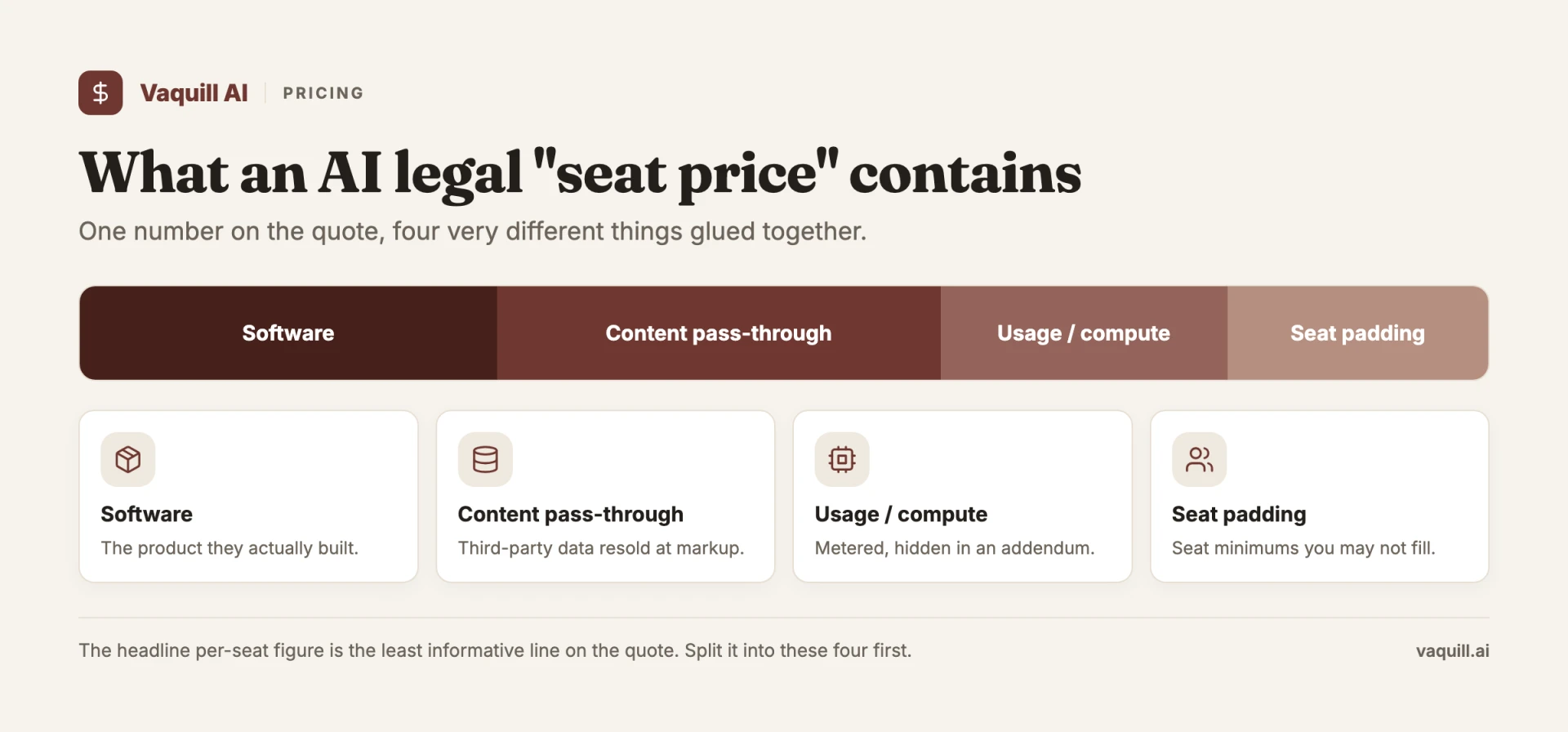
- Seat minimums are the real lockout. Harvey is reported near a 25-seat floor and Legora near 10. A five-person team buys ten seats and pays for five empty chairs.
- Self-serve is rare. Most tools here require a sales call before you can buy at all.
- Widen the lens past the enterprise shortlist and more tools do publish. Outside the ten, AI.Law lists per-seat tiers from $149 to $699, Clio Duo adds AI for a reported $49 to $59 on a base seat, and Casefleet posts both its rate and its overage rates. The transparency problem is concentrated at the enterprise tier, not the whole market.
How many of the ten shortlisted tools publish a real per-seat price?
Part of our legal AI vendor comparison and pricing series.
Methodology
This benchmark covers the ten tools an in-house legal team most often shortlists in 2026. They span the three buying patterns a department faces. AI-native research and drafting platforms: Harvey, Legora, and Paxton. The research incumbents' AI tiers: CoCounsel on Thomson Reuters, Westlaw Precision with CoCounsel, and Lexis+ with Protege. Word-native contract assistants: Spellbook and GC AI. Contract lifecycle management: Ironclad. And a self-serve suite. Consumer chatbots and single-feature point tools are out of scope. They do not compete for the same line in a legal budget.
Every figure was checked in June 2026. Each one is tagged by where it came from. The weaker the source, the more you should hedge it.
- Vendor page. A price the vendor posts on its own site. The strongest source. Stated as fact.
- Buyer-reported quote. A number a real buyer was actually quoted. Strong, but it is one deal, not a list.
- Reseller listing. A packaged tier on a third-party storefront. Useful, but not the vendor's own rate.
- Pricing-blog or competitor estimate. A figure a pricing blog or a rival put together. This is the weakest tier. Treat it as a rough band, not a fact.
A note on units. Where a tool sells an annual contract, the monthly figure is the annual list divided by twelve. That keeps all rows on the same unit. Ironclad prices by volume, not seats, so its row stays an annual range. Dividing it into a per-seat number would invent precision that is not there. Implementation, training, and renewal-uplift figures are third-party estimates, not posted prices.
Two more notes. The monthly ranges for Harvey, Legora, and CoCounsel come from vendor interviews and third-party pricing blogs, not a rate card. This post names the source on each and treats the band as reported. And widely repeated buyer claims, like quotes moving on pushback, are stated as general observations. No vendor publishes a discount rate, so this post invents no percentage.
Because so many figures here are third-party, this is a living page. Was your firm quoted a different number? Email it to contact@vaquill.ai and we will verify and update the row.
How to read this legal AI pricing benchmark
Read the table as two things at once. What each tool costs, and how hard the vendor makes it to find that out. The "Transparency" column matters as much as the price. A number you cannot see before a demo is a number you cannot budget against.
The "Source" column tags each price by confidence on a three-step scale. All figures are reported June 2026.
- HIGH. A price the vendor posts on its own site (for example, GC AI's published Individual tier). Treat it as fact.
- MEDIUM. A reseller listing or a buyer-reported quote. One real data point, not a list.
- LOW. A third-party pricing-blog or competitor-reported estimate. A rough band, not a fact.
One more framing before the grid. The ten tools split into per-seat pricing and enterprise contracts. Comparing across that line is how budgets go wrong, which the worked scenario below shows.
| Tool | Pricing model | Public price per seat | Min seats | Free trial | Access | Transparency | Source (confidence) |
|---|---|---|---|---|---|---|---|
| Vaquill AI | Flat per seat | Self-serve, published | 1 | Yes, 7-day | Self-serve | Published | vendor page (HIGH) |
| Harvey | Bundle + add-ons; metered credits | $1,200 to $2,000+/mo; ~$2,400 Lexis-bundled | ~25 | No | Sales-gated | Opaque | pricing-blog estimate, eesel (LOW) |
| Legora | Bundle + add-ons; metered credits | $300 to $800/mo; ~$3,000/yr list | ~10 | No | Sales-gated | Opaque | competitor-reported estimate, Spellbook (LOW) |
| CoCounsel (Thomson Reuters) | Quote-based AI line, usually bundled | $225 to $400+/mo standalone AI line | Quote | Demo only | Sales-gated | Opaque | pricing-blog estimate, Costbench (LOW) |
| Westlaw Precision with CoCounsel, bundle | Research seat + AI add-on | ~$250 to $650/mo all-in (bundled solo) | Quote | 7-day | Sales-gated | Partial | vendor page + pricing-blog estimate, AI Vortex (MEDIUM) |
| Lexis+ AI / Protege, bundled add-on | Base seat + AI add-on | ~$250 to $500/mo all-in; base ~$171 | Quote | Demo only | Sales-gated | Opaque | reseller listing + pricing-blog estimate (MEDIUM) |
| Spellbook | Per seat, quote-based | ~$500/mo base; not published | Team-tied | 7-day | Sales-gated | Opaque | pricing-blog estimate, Bind (LOW) |
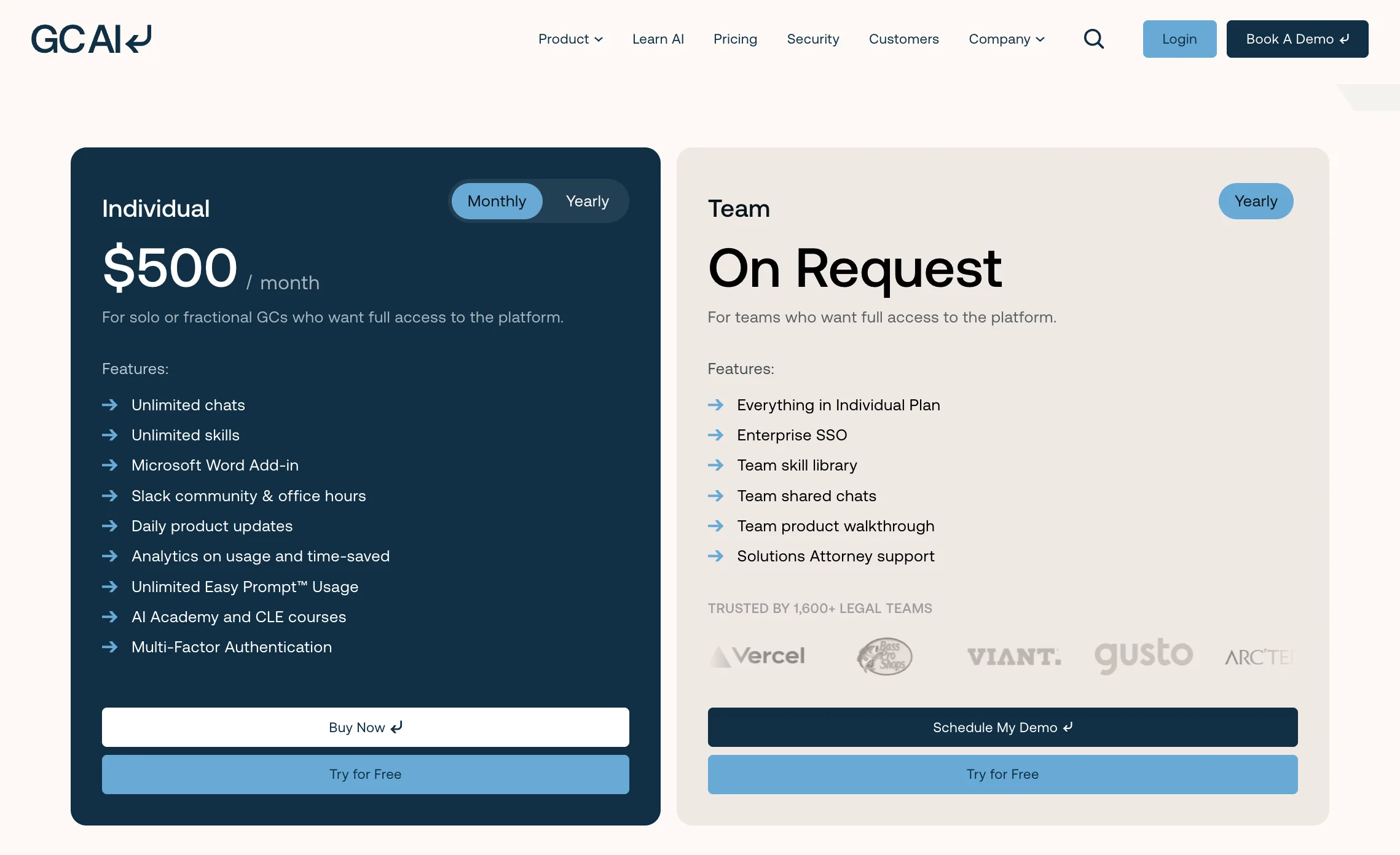
| GC AI | Per seat, published Individual tier | $500/mo Individual; Team/Enterprise quote | 1 (Individual) | 14-day | Self-serve trial, then sales | Partial | vendor page (HIGH) |
| Paxton | Per seat, published self-serve | $499/mo self-serve; $2,999/yr; $29 student | 1 | 7-day | Self-serve | Published | vendor page + Lawyerist, Costbench (HIGH) |
| Ironclad (CLM) | Quote, by contract volume | No per-seat rate; ~$30k to $150k+/yr | Quote | Demo only | Sales-gated | Opaque | pricing-blog estimate, Bind (LOW) |
Three rows blur product lines, so read them carefully. CoCounsel now sells primarily bundled with Westlaw. A standalone CoCounsel Legal line exists, but it is quote-based, and one pricing blog puts that AI line near $225 to $400 on its own (checked June 2026). Westlaw Precision with CoCounsel is the bundle most buyers actually purchase, where the AI rides on a Westlaw research seat, so the all-in solo figure lands in the mid-hundreds per month. Lexis+ AI / Protege is a bundled add-on too, sold on top of a base Lexis research seat estimated near $171. The Harvey, Legora, and CoCounsel monthly ranges are estimates, not posted rates. Ironclad does not sell by the seat at all, so its row is an annual contract range.
It helps to keep the Westlaw tiers straight, because they are easy to blur. Westlaw Classic is the base research platform. Westlaw Edge adds analytics. Westlaw Edge with AI-Assisted Research is the one tier Thomson Reuters publishes a self-serve price for (from $155.35/month on a three-year term for firms up to 10 attorneys). Westlaw Precision is the newer research tier, and Precision with CoCounsel is the top generative-AI bundle, which is quote-only. Only the AI-Assisted Research tier has a public Thomson Reuters number; the Precision-with-CoCounsel all-in figure is a third-party estimate.
The seven primary sources behind these rows, all checked June to July 2026, with the highest-value links. Three are published vendor pages (the strongest tier): GC AI's official pricing page ($500 Individual seat), Paxton's pricing page (self-serve tiers, corroborated by the Lawyerist and Costbench write-ups), and the Thomson Reuters Westlaw Edge with AI pricing page (the one published research-AI tier). Four are third-party estimates (the weakest tier, treated as rough bands): eesel AI's Harvey breakdown (Harvey ranges, seat floor, hidden fees), AI Vortex's Lexis pricing analysis (Lexis and Westlaw all-in bands), Bind's Ironclad pricing breakdown (Ironclad annual range), and Spellbook's Legora vs Harvey brief (the Legora list price, a competitor guide). The CoCounsel bundled-solo figure comes from a Costbench pricing breakdown, which blocks automated checks, so it is named here without a link. For deeper per-tool teardowns, see the Harvey vs Legora vs CoCounsel pricing breakdown and how much Westlaw costs.
Why so much of this is quote-based
Seven of the ten tools hide their price. That is a choice, not an accident, and the reason is the same across the category.
These are venture-scale companies that have to sign large firms at four-figure seats to justify their valuations. A posted price anchors a buyer low. A quote lets the sales team read the room, learn your budget, and set the number to it.
So the demo comes first and the price comes last. By the time you see a figure, the rep knows your firm size, your practice areas, and how badly you want the tool.
That three-of-ten count is for the enterprise shortlist a in-house team benchmarks against. Widen the lens and the self-serve market publishes freely, which is the next section.
Published-price tools outside the enterprise shortlist
The shortlist above is the set most in-house teams weigh against the enterprise platforms, and it is where the price is hardest to see. Zoom out to the self-serve tier and a different picture holds: several tools post a real number you can read and buy against today. They cover a narrower job than a full research-and-drafting suite, but for a lean team they belong in the same budget conversation.
| Tool | Published price per seat | Model | Source (confidence) |
|---|---|---|---|
| AI.Law | $149 / $299 / $699 by tier (Paralegal / Associate / Partner); 10% off annual | Per seat, self-serve | vendor page, ai.law/pricing (HIGH) |
| Clio Duo | AI add-on on a case-management seat | Clio + The Legal Prompts, Feb 2026 (MEDIUM) | |
| Casefleet | $30 to $40/mo Starter; $140 to $180/mo Advanced AI | Per seat, self-serve, plus metered overages | vendor page, casefleet.com (HIGH) |
AI.Law splits its per-seat tiers by role: a $149 Paralegal seat for intake and review, a $299 Associate seat that adds research and drafting, and a $699 Partner seat for litigation prep, all with a 10 percent annual discount and a $999-a-month owners' add-on (ai.law/pricing, checked July 2026). Clio Duo is not a standalone product; it is an AI layer that rides on a Clio case-management seat, which is why its all-in figure only makes sense stacked on the base subscription (Clio's 2026 legal AI pricing guide; The Legal Prompts pricing comparison, Feb 2026). Casefleet publishes the whole picture, seat price and per-unit overage rates both, which is rare enough in this category to be worth the mention.
The takeaway is not that these tools are interchangeable with Harvey or Legora. It is that opacity is a choice tied to the enterprise sales motion, not a fact of building legal AI. A vendor selling self-serve can post a number, and many do.
What changed since 2025
The pricing shape moved in four ways over the past year, and each one favors the vendor.
AI tiers went quote-based. A year ago more tools posted at least a starting AI price. Now the agentic and "Precision" tiers are sales-gated almost across the board, so the published numbers you can find are entry tiers, not the seat you would actually buy.
The incumbents bundled AI into the base subscription. Westlaw and Lexis folded their AI layers onto the research seat rather than selling them clean. That makes the AI look cheaper on its own line and hides the real cost inside a subscription you were already negotiating.
Seat minimums became standard. The 10-seat and 25-seat floors that used to be a big-firm thing now show up on mid-market quotes too. For a five-lawyer team, the minimum, not the rate, is the number that rules a tool out.
Flat seats started giving way to usage credits. Harvey and Legora both added metered credit plans next to the flat seat. That helps bursty teams, but it also moves you from a predictable monthly bill to a meter you have to watch.
The split that decides everything: per-seat vs enterprise contract
The ten tools fall into two pricing shapes, and confusing them is how budgets blow up.
Per-seat tools charge by the lawyer. Harvey, Legora, Paxton, GC AI, Spellbook, the self-serve suites, and the research seats all work this way. Your bill is seats times rate times months.
Enterprise contracts charge by volume or scope. Ironclad is the clear case: it prices on contract throughput and workflow complexity, so its reported $30,000 to $150,000-plus annual range has no clean per-seat translation. Westlaw and Lexis blur the line, since the AI seat rides on a research subscription that is itself negotiated.
If you compare a per-seat sticker against an enterprise annual contract, you are comparing two different things. Always convert both to the same unit, cost per active lawyer per year, before you decide.
A worked scenario: five-lawyer in-house team
Numbers in the abstract hide the real gap. Here is one team, two paths.
Take a five-lawyer in-house department that wants AI on every desk for research, drafting, and contract review. Compare a typical AI-native tool carrying a 10-seat minimum at an estimated $300 per seat per month (the low end of the Legora band) against a published self-serve plan billed annually.
| Line item | 10-seat-minimum tool (~$300/seat) | Published self-serve plan |
|---|---|---|
| Seats you must buy | 10 (minimum), 5 used | 5 |
| Annual license | ~$36,000 (10 x $300 x 12) | A published self-serve price, far less |
| Cost per active lawyer | ~$7,200/yr | Far less, self-serve |
| Empty-seat waste | ~$18,000/yr (5 unused seats) | $0 |
| Implementation / onboarding | estimated $5,000 to $50,000 | $0 |
| Premium support (estimated ~15-20% of license) | ~$5,400 to $7,200 | $0 |
| Year-1 floor | ~$46,000 to $93,000 | A fraction of that |
The license figure, seat minimum, implementation band, and support percentage for the enterprise path are third-party pricing-blog estimates, not posted prices. The $300 seat is the low end of the estimated Legora range. The self-serve column uses a published self-serve list price, billed annually, with no add-ons.
The point is not the exact total. It is the structure. At a 10-seat minimum, a five-lawyer team pays for ten seats and uses five. So the effective cost per active lawyer is double the sticker before a single add-on. The empty-seat line alone, about $18,000 a year, is larger than the entire self-serve bill. That gap is the seat minimum doing its work, not the per-seat rate.
Per-tool notes: what each price includes (and what it hides)
The headline rate is the start of the bill, not the end. Here is what sits inside each price and what surfaces after the demo.
Harvey
One pricing blog estimates $1,200 to $2,000+ per seat per month for unlimited AI usage (eesel AI, 2026; linked in the source list above). The same source puts a base seat near $1,200 and a full Lexis-bundled seat near $2,400. The range is wide because Harvey sells a base tier plus per-feature add-ons, and a metered credit plan now sits alongside the flat seat. The hidden weight is the seat minimum, estimated near 25 seats on a 12-month term, which sets a floor around $360,000 a year before add-ons. A separate pricing breakdown reads the same band off Metronome billing data at roughly $12,000 to $16,800 per seat a year, which is $1,000 to $1,400 a month (Casefleet, 2026), so two independent estimates land in the same place. Year-1 overhead (implementation, training, premium support, fine-tuning) is modeled at 30 to 50 percent above the license. Harvey runs the same frontier models you can license direct, so the premium pays for the integrations, agent scaffolding, and onboarding, not a smarter model.
Legora
One competitor guide claims $300 to $800 per seat per month (Spellbook, 2026; linked in the source list above). The same guide lists about $3,000 per seat per year on a 10-seat minimum, putting the smallest realistic contract near $30,000 a year. Same shape as Harvey: a bundle whose add-ons set the seat number, plus a pay-as-you-go credit option. In June 2026 Legora moved its Agent Pro tier to consumption-based pricing (legora.com), so metered usage is now the default on that tier. The draw is the tabular review grid for high-volume diligence. Hidden costs reported by buyer guides include custom integration with your document system, dedicated onboarding, and training, none published as a number.
CoCounsel (Thomson Reuters)
CoCounsel now sells primarily bundled with Westlaw. A standalone CoCounsel Legal line still exists, but it is quote-based, and one pricing blog puts that AI line near $225 to $400-plus per seat per month. Most buyers pay for the bundle, where CoCounsel rides on a Westlaw subscription. A solo on Westlaw Advantage with CoCounsel and all-states-plus-federal coverage is estimated in the mid-hundreds per seat per month on a one-year term (Costbench, checked June 2026; not linkable, so treat as a rough figure). The cost that hides here is the research subscription underneath. Model the bundle, not the $225 entry line.
Westlaw Precision with CoCounsel
Thomson Reuters now publishes self-serve prices for some Westlaw research tiers, but only for new-customer firms up to 10 attorneys. For example, Westlaw Edge with AI-Assisted Research starts at $155.35/month on a three-year term, per the Thomson Reuters pricing page linked in the source list above. That is why this row grades partial rather than fully opaque. The top generative-AI Precision tier is still quote-only. One pricing blog estimates all-in figures at roughly $250 to $500 per seat per month (AI Vortex, 2026; linked in the source list above). Hidden costs: per-search overage billing for out-of-plan use, multi-year lock-in (with a reported 12 to 18 percent cut for two- and three-year terms), and content packages scoped by jurisdiction.
Lexis+ with Protege
The base non-AI research seat is estimated near $171 per month. The AI layer (Protege, the agentic tier) sits on top as a separate quoted premium. One pricing blog estimates all-in figures at roughly $250 to $500 per seat per month (AI Vortex, 2026; linked in the source list above). Reseller listings put packaged AI tiers at $128, $314, and $494 per month, which are reseller numbers, not a LexisNexis rate card. A separate breakdown reverse-engineers the stack into estimated component lines: legal search near $99, generative drafting near $250, and document summarization near $250 a month (The Legal Prompts, Feb 2026), which is why the "all-in" number climbs so fast once you turn on more than search. The four hidden drivers: multi-jurisdiction content unlocks, annual auto-renew lock-in, integration pass-through (paying for Lexis content twice if it also rides inside a tool like Harvey), and cancellation friction.
Spellbook
One pricing blog estimates a $500 per seat per month base, quote-based, with a 7-day trial (longer for larger teams). It is the polished Word-native option for in-house and deal lawyers who live in Microsoft Word, with playbook deviation checks and clause-level market data. The cost buyers miss is the minimum commitment. One pricing blog reports a 6-month minimum before you can pilot it (Bind, 2026; linked in the source list above). It does not do research, a document matrix, citation checks, matter management, or an API.
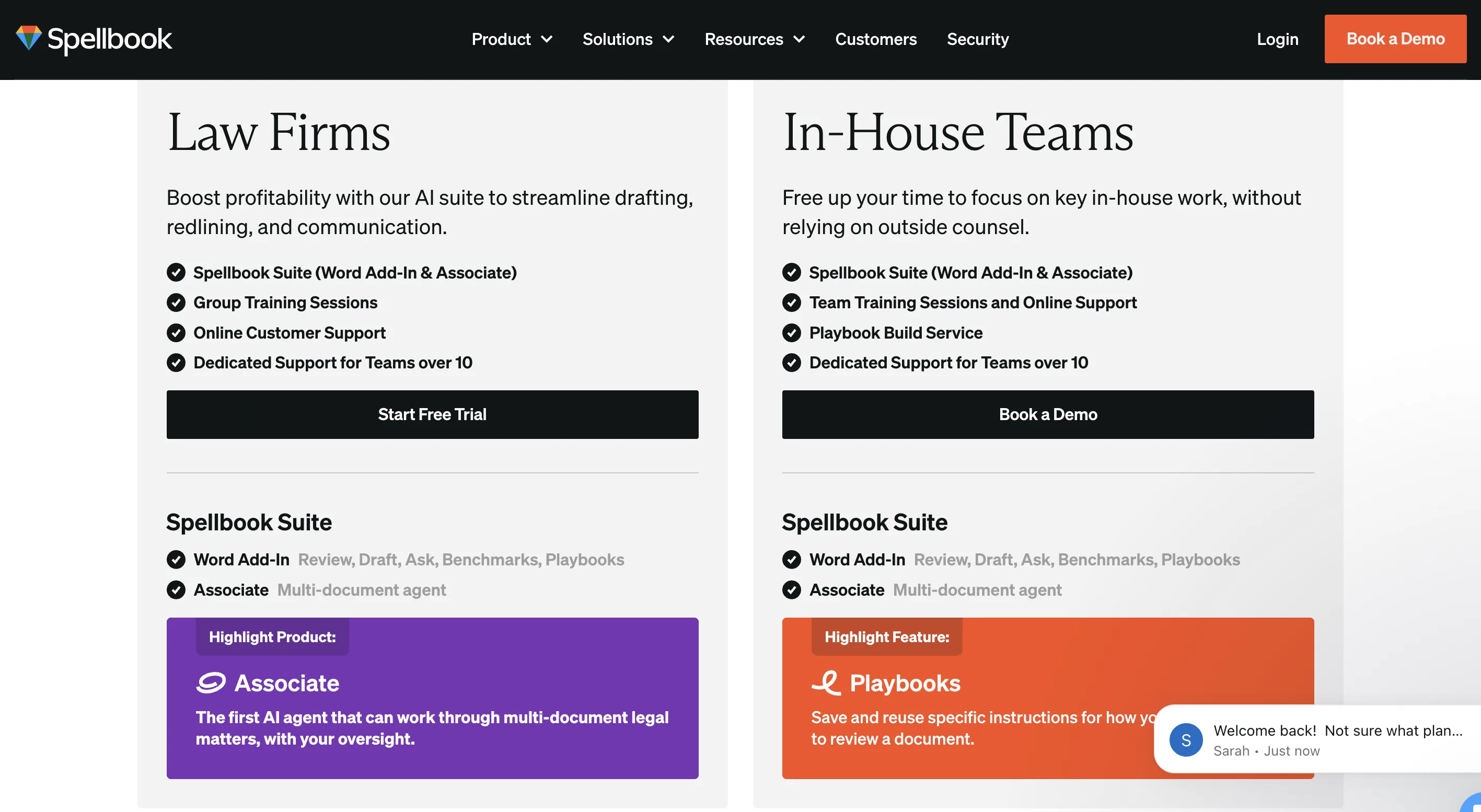
A caution on any single Spellbook number: because the vendor publishes nothing, third-party estimates diverge more here than for almost any other tool in this benchmark, and older breakdowns floated per-seat guesses far below the mark. The current reporting anchors the base near $500 a seat, quote-gated (Bind, 2026). That spread is itself the signal. When a vendor publishes nothing, every "price" you find is a guess dressed as a fact, and they do not agree.
GC AI
The clearest pricing in the enterprise tier: a published $500 per seat per month for the Individual plan, a 14-day trial, no credit card, and no seat minimum on that plan (gc.ai/pricing, June 2026). Team and Enterprise tiers move to a sales quote. It is built around the in-house contract week (NDAs, DPAs, vendor MSAs) inside a Word add-in, with SOC 2 Type II security. The gaps are research depth past contract review and a public API still in private beta.
Paxton
One of the few tools here you can price without a sales call. Paxton publishes a self-serve seat on its pricing page at $499 per seat per month, roughly $2,999 per year on annual billing, and a $29 per month student rate, with a 7-day trial and a custom Enterprise tier (paxton.ai/pricing, checked July 2026; corroborated by the Lawyerist and Costbench write-ups). It leans toward legal research, case analysis, and litigation support rather than the full in-house contract-and-matter workflow, so a in-house department still checks that the research focus matches its actual week before it buys.
Ironclad
Not a research or drafting assistant. Ironclad is contract lifecycle management, priced by contract volume and workflow scope, with no published per-seat rate. One pricing blog estimates deals from about $30,000 to $150,000-plus a year (Bind, 2026; linked in the source list above). Implementation adds $5,000 to $50,000 on top, so a first-year total can reach the low six figures. Because it prices on throughput, a per-seat figure for Ironclad is a rough division, not a posted rate. Budget it as an enterprise contract, not a per-lawyer subscription.
Vaquill AI
A self-serve, published price (sign up for the latest), at one seat, with a 7-day trial and no sales call. The price covers research, drafting, and matter document management, with no implementation fee, no support percentage, and no renewal uplift. The honest tradeoff: it is built for solo GCs and in-house teams, not for a large firm running deep M&A diligence agents, where the enterprise platforms have more depth.
The transparency tax
Opaque pricing is not free to the buyer. You pay for it in three ways.
You pay it in the weeks spent in demos to learn a number a webpage could have shown you. You pay it in lost leverage, because the rep sets your price after learning your budget. And you pay it at renewal, when the uplift lands on a contract you cannot easily benchmark against anyone else.
In our vendor conversations, quote-based prices tend to move on pushback, sometimes by a large margin. That is its own signal. A price that drops materially on one email was an opening bid, not a floor. The whole reason to push is that you cannot see where the floor is. A published price removes that game, because the renewal is the same number you started with and there is nothing to negotiate.
How a in-house team should budget
If you run a one-to-ten-person legal team, most of this market is not priced for you. Here is how to budget around it.
Start from the job, not the brand. Most in-house weeks are contract review, research, drafting, and keeping matter documents organized. That work does not need a four-figure seat built for AmLaw M&A volume.
Convert every quote to all-in per-active-lawyer per-year. Take the seat price and multiply by the seat minimum, not your headcount. Add implementation and support. Then divide by the lawyers who will actually log in. As the worked scenario shows, the result is often two to ten times the sticker.
Budget the empty chairs. A five-person team on a 10-seat-minimum tool is paying double per active lawyer. Price that in before you fall for the headline rate.
Get three things in writing before any demo. First, the all-in per-seat price with every content package named. Second, the contract term and cancellation window. Third, whether a Lexis or Westlaw license is already bundled inside any integrated tool you are evaluating, so you do not buy the same content twice.
What this looks like at the order-form stage
A few concrete patterns from real procurement, so you know where the costs hide.
The seat minimum rarely shows up in the demo. It shows up on the order form as a "minimum committed quantity" or "licensed users" line, often set above your headcount. Read that line before you sign. If it says 10 and you have 5 lawyers, you are paying for 10.
The renewal uplift is the one to negotiate up front. Vendors often reserve a 10 to 25 percent annual increase, sometimes uncapped. Ask for a written cap in the 5 to 7 percent range, in the order form, not the email thread. Year-2 is where an "affordable" Year-1 quote catches up with you.
Content-package scope is the line that quietly resets your price. Research seats from Westlaw and Lexis bundle content by jurisdiction or practice area. The "base" seat may not cover the states or libraries your team actually uses, so a second jurisdiction is a paid add-on, not an upgrade you assumed you had.
Usage credits are the newer trap. Harvey and Legora now offer metered credit plans next to the flat seat. Ask what one credit buys, how fast a heavy week burns them, and what an overage costs. A plan that looks cheap at signup gets expensive when a deal sprint drains the bucket and you pay per-credit on top.
Professional services hide in a separate line. Implementation, data migration, and custom integration are billed apart from the license, often as a one-time fee in the tens of thousands. Get that number in the same quote as the seats, not in a follow-up statement of work.
Here is what those lines look like on a real order form, anonymized from a mid-market quote. The language is the part to watch.
| Order-form line | Typical wording | What to push on |
|---|---|---|
| Minimum committed quantity | "Licensed Users: 10 (minimum)" | Match it to real headcount, not a floor |
| Subscription term | "Initial Term: 36 months, auto-renewing" | Shorten the term; kill auto-renew |
| Renewal uplift | "Annual increase up to 7%" or silent | Get a written 5 to 7% cap |
| Content-package scope | "Jurisdictions: Federal + 1 state" | Name every state and library you need |
| Implementation | "Professional Services: one-time fee" | Get the dollar figure in this same quote |
| Usage credits | "Included credits: N; overage billed per credit" | Ask what one credit buys and the overage rate |
The NDA is the gate to the quote, so use it. Before you sign one just to see a price, ask four questions in writing: the all-in per-seat number for your exact seat count, the minimum committed quantity, the renewal-cap policy, and the implementation fee. A vendor that will not answer those before the NDA is telling you how the rest of the deal will go.
The caps and overages the demo skips
The seat rate is the price to log in. It is not always the price to do the work. Several tools meter usage on top of the seat, and the caps rarely surface in a demo. They surface the week a deal sprint or a document dump blows past them.
Casefleet is the tool that publishes its own limits and overage rates in full, which makes it a useful worked example of how metering actually reads on a bill.
| Metered line | Included per user/month | Overage rate | Source |
|---|---|---|---|
| AI credits | 100,000 credits | $0.001 per credit | casefleet.com pricing, 2026 |
| OCR pages | 3,000 pages | $1 per 100 pages | casefleet.com pricing, 2026 |
| Document intelligence | 12,000 pages | $0.01 per page | casefleet.com pricing, 2026 |
| Media transcription | 3 hours | $0.06 per minute | casefleet.com pricing, 2026 |
| Storage | 5 GB | $10 per GB/month | casefleet.com pricing, 2026 |
The quote-based tools rarely publish their ceilings, so buyers only learn them from the docs or from hitting a wall. Practitioner-reported and documentation-sourced caps include CoCounsel's 200 files maximum per review run and roughly 50 results per search, and Lexis+ Protege's 25 Deep Research conversations a month, 10 files per upload session at 20 MB each (all Casefleet, 2026). Harvey's API throttles at 20 requests a minute on its Assistant endpoint. None of these is a dealbreaker on its own. Together they are the difference between "unlimited" as marketed and "unlimited within limits" as billed.
Where each tool fits
Price is only half the call. Fit is the other half.
- Harvey and Legora earn their four-figure seats at large firms running deep due-diligence and M&A agent workflows. Below that scale, you pay for agents nobody opens.
- CoCounsel and the Westlaw and Lexis AI tiers make sense when you already live in that research platform and want KeyCite or Shepard's alongside the AI.
- Spellbook and GC AI fit contract-heavy in-house teams who work inside Microsoft Word all day.
- Ironclad is contract lifecycle management for high contract throughput, not a research or drafting assistant.
- Self-serve suites fit solo GCs and in-house teams who want research, drafting, and matter documents without a sales call.
For more buyer detail, see a three-way research-pricing breakdown, the best legal AI tools for in-house counsel, and the legal AI seat-cost buyer guide.
When the cheapest tool is the wrong choice
A benchmark that ends "buy the cheapest seat" would be lying to you. For several buyers, a self-serve tier is the wrong first choice, and paying five to ten times more is the rational call. Here is when.
You do case-law research at scale. A litigation shop that lives in primary research all day needs depth a lean suite does not match. Westlaw and Lexis carry decades of editorial work, and that breadth is worth real money to a team that bills against it.
You need editorial headnotes and a citator. KeyCite (Westlaw) and Shepard's (Lexis) tell you whether a case is still good law. No self-serve tool replaces that signal. If your practice turns on current treatment, pay for the citator.
You face big-firm security and procurement requirements. Enterprise SSO, custom data-residency terms, a signed BAA, audit logs, and a vendor security review are table stakes at large firms. The enterprise platforms staff those. A self-serve tool may not clear your procurement gate.
You work a specialized-practice corpus. Tax, IP prosecution, and some regulatory fields depend on specialized libraries and treatises. If your work needs that corpus, the platform that licenses it wins, whatever the seat costs.
You run deep agent workflows on real volume. A 40-lawyer M&A team running diligence agents across hundreds of contracts a week can justify Harvey or Legora. The workflow depth pays back at that volume in a way it never does for a five-person team.
For these buyers, the four-figure seat is not overpriced. It is priced for the work. The mistake in either direction is the same: matching the tool to the brand instead of the job.
FAQ
Which legal AI tools publish their pricing? Of the ten here, only three post a real per-seat number on their own site. GC AI publishes $500 per seat per month for its Individual plan (gc.ai/pricing, June 2026), Paxton publishes a $499-per-month self-serve seat (paxton.ai/pricing, July 2026), and one self-serve suite publishes a self-serve per-user price. Harvey, Legora, CoCounsel, Westlaw, Lexis+, Spellbook, and Ironclad are quote-based, so their figures in the table are reported third-party numbers, not vendor rate cards.
How much does Harvey cost per seat? One pricing blog estimates $1,200 to $2,000+ per user per month for unlimited AI usage. The same source puts a base seat near $1,200 and a Lexis-bundled seat near $2,400 (eesel AI, 2026). Harvey publishes no price. A roughly 25-seat minimum puts the smallest realistic contract near $360,000 a year at the base seat, and past half a million at the Lexis-bundled rate.
How much does Legora cost? One competitor guide claims $300 to $800 per user per month. The same guide lists about $3,000 per seat per year on a 10-seat minimum (Spellbook, 2026). That puts the smallest realistic contract near $30,000 a year before add-ons.
What does Ironclad cost per user? Ironclad does not sell by the seat. It prices on contract volume and workflow scope. One pricing blog estimates deals from about $30,000 to $150,000-plus a year, with implementation of $5,000 to $50,000 on top (Bind, 2026). Treat any per-seat figure for Ironclad as a rough division, not a posted rate.
Why is most legal AI pricing hidden? These are venture-scale vendors that need four-figure enterprise seats to justify their valuations, and a posted price would anchor buyers too low. Quotes let the sales team set your number after learning your budget, which is why, based on buyer accounts, prices often move on pushback.
How much do Westlaw and Lexis AI seats cost? One pricing blog estimates all-in figures for both at roughly $250 to $500 per seat per month, once the AI layer sits on the base research subscription (AI Vortex, April 2026). The base Lexis research seat is estimated near $171 per month. The top AI tiers are quote-based.
What is the cheapest legal AI tool with a published price? Inside the ten-tool shortlist, the three published prices are a self-serve suite (published, self-serve), Paxton's $499-per-month self-serve seat, and GC AI's Individual plan at $500 per seat per month. Widen the lens past the enterprise shortlist and cheaper published options exist: Clio Duo adds AI to a base Clio seat for a reported $49 to $59 a month, Casefleet's Starter tier lists at $30 to $40 a seat, and AI.Law posts a $149 Paralegal seat (ai.law/pricing and Clio's 2026 guide; The Legal Prompts, Feb 2026). The quote-based enterprise tools may come in lower or higher, but you cannot know without a sales call, which is the point of the transparency grade.
Can I negotiate these prices down? For the quote-based tools, buyer accounts point to material discounts after pushing back on the first number. The levers are the add-on mix, the term length, and the seat count against the minimum. A price that moves a long way on one email tells you the list price was never the real one.
Do legal AI tools charge usage overages on top of the seat? Some do. Casefleet publishes its own metered rates: 100,000 AI credits, 3,000 OCR pages, and 5 GB of storage per user per month are included, then $0.001 per credit, $1 per 100 OCR pages, and $10 per GB after that (casefleet.com, 2026). The quote-based tools rarely publish their ceilings, but caps exist: CoCounsel reviews up to 200 files per run and Lexis+ Protege allows 25 Deep Research conversations a month (Casefleet, 2026). Ask what a peak week costs before you sign, not what an average one does.
How were these figures sourced and how current are they? Every number was checked in June 2026, with the Paxton row added in a July 2026 refresh. Three are published vendor prices. The rest are reported third-party figures from named pricing blogs, buyer guides, reseller listings, and vendor interviews. Annual contracts are normalized to a monthly per-seat figure where the tool sells by the seat. See the Methodology section for the full approach.
Last updated and corrections
Last updated: July 2026. This is a maintained benchmark, so it gets a real refresh as prices and tiers change, not a cosmetic date bump. The latest refresh added Paxton as a third self-serve publisher, a section on the published-price tools outside the enterprise shortlist (AI.Law, Clio Duo, Casefleet), a caps-and-overages breakdown with real metered rates, and a re-check of which vendors post a price you can read without a demo.
Spotted a number that is stale or wrong, or a price your firm was actually quoted? Email corrections to contact@vaquill.ai and we will verify and update the row, with the new source noted. The point of this page is to be the accurate, citeable reference for legal AI pricing, which only works if the figures stay honest.
The three published vendor-page prices among the ten shortlisted tools (GC AI, Paxton, and the self-serve suite) are stated as fact, as are the AI.Law and Casefleet vendor-page prices in the self-serve section. Every other figure is reported or third-party, carries a named and dated source, and is hedged because those vendors publish no rate card.
New legal AI guides, weekly.
Further Reading
How to Verify a Legal AI Accuracy Claim (Before You Trust the Number)
Read postGC AI Pricing 2026: What It Actually Costs Per Seat
Read postIronclad Pricing 2026: CLM Cost Ranges and the AI Add-On
Read postIvo Pricing 2026: What AI Contract Review Costs Per User
Read postLegalOn Pricing 2026: Base Cost Plus Modules, Explained
Read postSpellbook Pricing 2026: Per-Seat Cost and Total Cost of Ownership
Read post
Co-Founder & CEO · Attorney
Arshita leads product and strategy at Vaquill, building the legal AI suite that solo, small-firm, and in-house US lawyers use to run a matter end to end.

